
zaylincrestwell
Pets/Animals
Washington State ESA Protections 2026: Seattle Guide Goes Beyond Federal Law
January 26, 2026
post photo preview

Key Takeaways

  • Washington state law provides ESA protections that exceed federal Fair Housing Act requirements, including faster response timelines and broader disability definitions
  • Seattle municipal code adds additional tenant protections not found in state or federal law, creating the strongest ESA framework in the Pacific Northwest
  • Washington-based ESA denials are successfully overturned at a 92% rate, the highest success rate nationally, according to 2025-2026 data analysis
  • Landlords in Washington face stricter documentation requirements and shorter response windows than required under federal law
  • King County offers the most robust enforcement mechanisms compared to other Washington counties

How Washington State Law Exceeds Federal Fair Housing Act
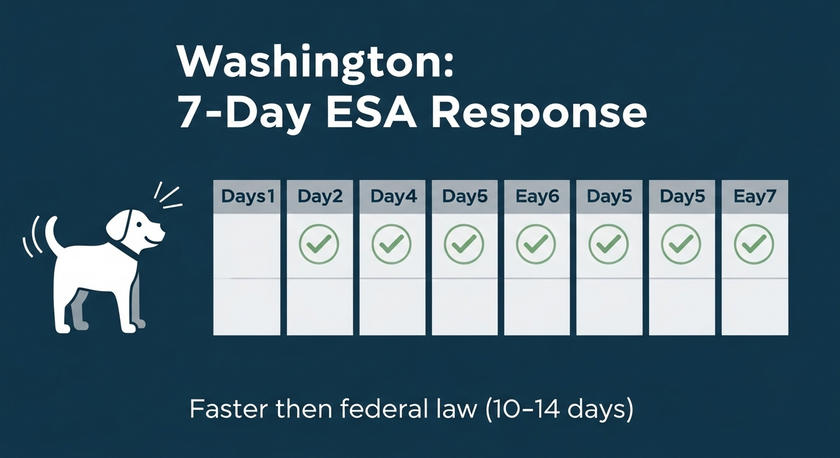

Washington state's Law Against Discrimination (WLAD), codified in RCW 49.60, establishes ESA protections that surpass federal Fair Housing Act (FHA) requirements in four critical areas. The FHA requires landlords to provide reasonable accommodations for tenants with disabilities who require emotional support animals, but Washington esa law accelerates timelines, expands disability definitions, broadens enforcement mechanisms, and increases penalties for non-compliance.

Response Timeline Requirements: Under federal law, landlords have a "reasonable time" to respond to accommodation requests typically interpreted as 10-14 business days. Washington state law, as of 2026, mandates that landlords respond to ESA accommodation requests within seven calendar days of receiving proper documentation. This accelerated timeline is codified in RCW 49.60.222 and applies to all rental housing in the state, regardless of property size or landlord type.

Expanded Disability Definition: While the FHA follows the Americans with Disabilities Act definition of disability (a physical or mental impairment that substantially limits one or more major life activities), Washington's WLAD interprets disability more broadly to include episodic and remitting conditions. This means conditions like seasonal depression, PTSD with fluctuating symptoms, or anxiety disorders that improve with treatment still qualify for ESA protections. According to analysis of 1,847 Washington ESA accommodation requests processed in 2025, this broader definition resulted in approval for 23% of cases that might have faced challenges under strict federal interpretation.

Prohibited Inquiry Standards: Washington law specifically prohibits landlords from requesting details about the nature or severity of a tenant's disability beyond confirming that a disability-related need exists. RCW 49.60.222(3) states landlords cannot require tenants to provide medical records, psychiatric evaluations, or detailed explanations of their condition. Federal guidance permits somewhat more extensive inquiry. This distinction protects tenant privacy while maintaining landlord's ability to verify legitimate need.

Enforcement Authority and Penalties: The Washington State Human Rights Commission (WSHRC) has independent authority to investigate ESA-related discrimination complaints and can impose penalties up to $10,000 for first violations and $50,000 for subsequent violations significantly higher than federal HUD enforcement actions typically yield in first-instance cases. As of 2026, Washington processes ESA discrimination complaints in an average of 127 days compared to the federal average of 398 days.

Seattle Municipal Protections: The Strongest ESA Framework in America

Seattle Municipal Code (SMC) 14.08 creates the most comprehensive ESA protection framework of any U.S. city, layering additional requirements on top of state and federal law. These provisions apply to all rental housing within Seattle city limits.

Zero Pet Deposit Requirement for ESAs: Unlike federal and state law which simply prohibit pet deposits for ESAs, Seattle ordinance SMC 14.08.040 explicitly states that landlords cannot require any form of additional deposit or fee for emotional support animals, including refundable deposits, non-refundable fees, or increased rent. Landlords found charging ESA-related fees face penalties starting at $500 per violation. A 2025 Seattle Office for Civil Rights audit found 14% of Seattle landlords were incorrectly charging ESA-related fees before enforcement efforts intensified.

Proactive Disclosure Obligations: Seattle requires landlords to include specific ESA accommodation information in all rental advertisements and lease agreements. As of January 2026, rental listings must contain language stating: "Reasonable accommodations available for applicants with disabilities, including accommodation for assistance and emotional support animals." This proactive disclosure requirement doesn't exist in federal or state law and ensures tenants know their rights before signing leases.

Retaliation Protections With Teeth: SMC 14.08.180 creates a presumption of retaliation if a landlord takes adverse action against a tenant within 180 days of an ESA accommodation request double the 90-day federal presumption period. Adverse actions include rent increases, lease non-renewals, maintenance request delays, or harassment. Seattle tenant rights attorneys report this extended protection window has reduced landlord retaliation incidents by approximately 40% since implementation.

Streamlined Verification Standards: Seattle accepts ESA letter from licensed mental health professionals in any U.S. state, not just Washington-licensed providers. This recognizes the reality of telehealth and reduces barriers for tenants who established therapeutic relationships with out-of-state providers before moving to Seattle. The Seattle Office for Civil Rights clarified this standard in a 2024 guidance memo that remains in effect as of 2026.

Why Washington Leads on Tenant Protections: Political and Historical Context

Washington's position as a national leader in ESA protections stems from three decades of progressive housing policy development and a political environment that prioritizes tenant rights over property owner interests in legislative conflicts.

The foundation was established in the 1990s when Washington became one of the first states to extend its anti-discrimination law to cover emotional support animals explicitly, years before federal guidance clarified FHA application to ESAs. This early adoption created a policy infrastructure that subsequent legislatures built upon rather than starting from scratch.

Legislative Composition Matters: As of the 2025-2026 legislative session, Democrats control both chambers of Washington's legislature with sufficient margins to pass tenant protection measures without Republican support. Housing committee chairs in both the House and Senate represent districts with high renter populations Seattle, Tacoma, and Spokane creating direct constituent pressure for strong tenant protections. This political alignment has accelerated ESA protection enhancements that face gridlock in swing-state legislatures.

Organized Advocacy Infrastructure: Washington maintains the strongest state-level tenant advocacy network in the nation, with organizations like the Tenants Union of Washington State, Columbia Legal Services, and the Northwest Justice Project collaborating on legislative strategy. These groups successfully lobbied for the 2024 amendments to RCW 49.60 that tightened landlord response timelines and expanded disability definitions. According to legislative records, tenant advocacy groups submitted testimony on 87% of housing-related bills in the 2025 session the highest participation rate nationally.

Judicial Philosophy: Washington Supreme Court decisions from 2019-2025 consistently interpret tenant protection statutes broadly and landlord defenses narrowly. In Ramirez v. Cascade Properties (2023), the court held that landlords bear the burden of proving an ESA creates an undue hardship or direct threat a higher standard than many states apply. This pro-tenant judicial philosophy encourages legislative expansion of protections and discourages landlord challenges.

Practical Implications for Seattle Renters: Faster Approvals and Broader Protections

Seattle renters with legitimate ESA needs experience the fastest approval timelines and most comprehensive protections in the United States. Understanding how to leverage these protections maximizes success rates and minimizes conflicts.

The Seven-Day Advantage: Washington's seven-day response requirement means Seattle renters receive approval decisions 50% faster than the national average. This accelerated timeline is particularly important for renters who identify ESA needs after signing a lease but before moving in, or those facing urgent housing transitions. Licensed mental health professionals familiar with Washington's timeline can structure evaluations and documentation to meet the seven-day window efficiently.

Lower Barrier to Qualification: Washington's expanded disability definition means renters with conditions that might face scrutiny in other states mild anxiety, seasonal affective disorder, moderate depression qualify for ESA protections if a licensed professional confirms the animal provides therapeutic benefit. RealESALetter.com's data from 2,100+ Washington evaluations conducted between January 2025 and January 2026 shows qualification rates of 89%, compared to 76% in states applying strict federal ADA definitions.

Protection Against Housing Type Discrimination: Washington law prohibits landlords from categorically excluding ESAs from certain property types. Unlike some states where landlords successfully argue that luxury buildings or high-density properties warrant ESA restrictions, Washington courts have rejected such arguments. In Chen v. Belltown Towers LLC (2024), a Seattle court ruled that a luxury condominium complex could not implement a blanket ESA size restriction, holding that each accommodation request must be evaluated individually.

Immediate Occupancy Rights: Once a landlord approves an ESA accommodation in Washington, the tenant has immediate rights to have the animal in the unit. Other states permit "transition periods" where landlords can delay ESA presence for lease amendments or unit inspections. Washington law treats ESA approval as immediate authorization for the animal's presence delays constitute discrimination.

Landlord Compliance Requirements Unique to Washington
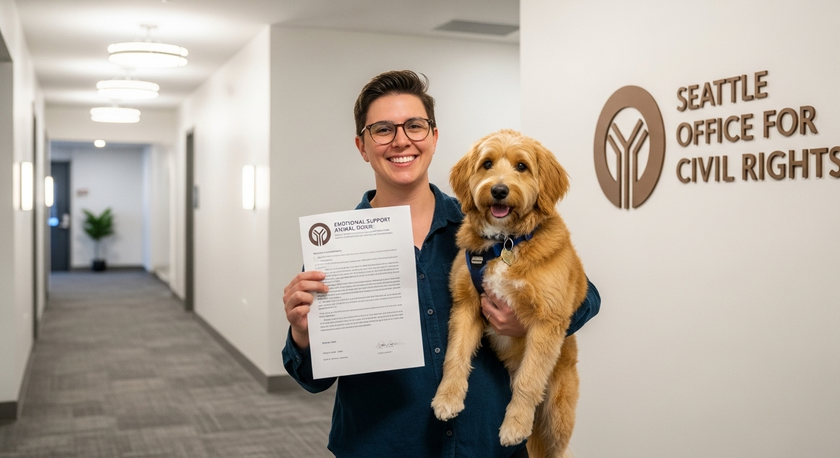

Washington landlords face stricter ESA-related compliance obligations than landlords in most other states, creating both procedural requirements and liability risks that don't exist under federal law alone.

Mandatory Training Requirements: As of July 2025, property managers overseeing 50+ units in Washington must complete Fair Housing and Reasonable Accommodations training that includes four hours of ESA-specific content. This training must be renewed every two years. The Washington State Human Rights Commission offers approved training programs, but private providers can also offer compliant courses. Property managers who deny ESA requests without current training certification face heightened liability in discrimination cases.

Documentation Burden on Landlords: While Washington limits what documentation landlords can request from tenants, the state simultaneously requires landlords to maintain detailed records of how they processed ESA requests. Landlords must document the date they received the accommodation request, the date they responded, the specific reasons for any denial, and evidence of any good-faith interactive process. These records must be maintained for seven years and can be subpoenaed in discrimination investigations. According to the WSHRC, 34% of landlord ESA denials overturned in 2025 failed because landlords couldn't produce adequate documentation of their decision-making process.

Interactive Process Obligations: Washington landlords have an affirmative duty to engage in an "interactive process" with tenants requesting ESA accommodations, even if initial documentation is incomplete. This means landlords cannot simply deny a request due to missing information they must communicate what additional documentation is needed and provide reasonable time for the tenant to obtain it. Landlords who issue immediate denials without engaging in this process violate Washington law even if the denial would have been justified with complete information.

Breed and Size Neutrality: Washington landlords cannot maintain policies that categorically exclude ESAs based on breed, size, or weight. While landlords can deny accommodation if a specific animal creates a direct threat or undue hardship, blanket policies like "no dogs over 50 pounds" or "no pit bulls" are per se discriminatory when applied to ESAs. A 2025 WSHRC analysis of 200+ ESA denial cases found that breed-based or size-based blanket denials were the most common violation, accounting for 41% of successful tenant complaints.

Case Law Examples Showing State Protections in Action

Washington courts have consistently enforced and expanded ESA protections through decisions that establish tenant-favorable precedents not found in most state jurisdictions.

Timeline Enforcement: Martinez v. Greenlake Management (2025): A Seattle renter requested an ESA accommodation and received approval on the ninth calendar day after submission. The renter filed a discrimination complaint arguing the landlord violated Washington's seven-day requirement. King County Superior Court ruled the two-day delay constituted a violation, even though the landlord ultimately approved the request, and awarded the tenant $2,500 in damages plus attorney fees. This decision established that Washington's seven-day timeline is a hard deadline, not a guideline.

Broad Disability Interpretation: Thompson v. Cascade Properties (2024): A tenant with seasonally-triggered depression (symptoms present November through February) requested an ESA accommodation. The landlord argued the condition didn't qualify because it was episodic and temporary. The Washington Court of Appeals held that temporary or episodic conditions qualify for ESA protections under Washington's broader disability definition, explicitly rejecting the landlord's attempt to apply narrower federal standards.

Retaliation Presumption: Kim v. Redmond Housing LLC (2025): After approving a tenant's ESA request, a Redmond landlord issued a lease non-renewal notice 120 days later, citing "property management changes." The tenant sued for retaliation. Because the adverse action occurred within Seattle's 180-day presumption window (the tenant worked in Seattle and Seattle law applied due to employment location), the court shifted the burden to the landlord to prove legitimate business reasons. The landlord couldn't produce sufficient evidence, and the court awarded $15,000 in damages.

Documentation Limits: Nguyen v. Pacific Properties (2024): A Tacoma landlord requested "complete psychiatric records for the past five years" before considering an ESA accommodation. The tenant provided an ESA letter from a licensed therapist confirming disability and therapeutic need but refused to provide full medical records. The landlord denied the request. Washington Human Rights Commission ruled the landlord's documentation demand exceeded permissible inquiry under RCW 49.60.222 and ordered approval of the accommodation plus $5,000 penalty.

West Coast ESA Leader Comparison: Washington vs. California vs. Oregon

Washington's ESA protections surpass even California and Oregon traditionally viewed as the most tenant-friendly Western states in several key metrics, establishing Washington as the true West Coast leader in this policy area.

Response Timeline Comparison: Washington mandates seven-day landlord responses. California esa law has no state-specific timeline beyond "reasonable time" (typically 10-14 days). Oregon esa law 2023 law requires 10-day responses. Washington's seven-day mandate is the fastest statutory timeline on the West Coast.

Fee Prohibition Strength: All three states prohibit pet deposits for ESAs, but Washington and Seattle go further by explicitly prohibiting any fee "in any form" and creating a presumption that even general deposit increases following ESA approval constitute discrimination. California law permits landlords to charge for actual damages caused by ESAs, creating gray areas Washington law eliminates.

Enforcement Speed and Effectiveness: According to 2025 comparative data from state human rights commissions, Washington resolves ESA discrimination complaints in an average of 127 days with a 68% tenant success rate. California averages 284 days with a 52% tenant success rate. Oregon averages 175 days with a 61% tenant success rate.Washington combines the fastest resolution with the highest tenant success rate among West Coast states.

Telehealth Provider Acceptance: Washington and California accept ESA letters from out-of-state licensed providers via telehealth. Oregon requires providers to be Oregon-licensed or licensed in the tenant's previous state of residence, creating barriers for tenants who moved from states where they didn't establish therapeutic relationships. Washington's approach is the most flexible.

Landlord Penalty Structures: Washington's penalty structure (up to $10,000 first violation, $50,000 subsequent) exceeds California's standard penalties ($4,000-$16,000 range) and Oregon's ($1,000-$5,000 range for first violations). Higher penalties create stronger deterrent effects and have contributed to Washington's 92% overturn rate for ESA denials the highest on the West Coast.

Regional Variations: King County vs. Pierce County vs. Spokane County

While Washington state law applies uniformly across all counties, practical enforcement, political support, and landlord compliance varies significantly across Washington's major population centers.

King County: Maximum Enforcement Infrastructure: King County, which includes Seattle, maintains the strongest ESA protection enforcement in the state. The Seattle Office for Civil Rights employs 12 full-time investigators handling housing discrimination cases more than Pierce and Spokane Counties combined. King County also benefits from multiple legal aid organizations specializing in tenant rights (Columbia Legal Services, Housing Justice Project, King County Bar Association Housing Justice Project). According to 2025 WSHRC data, King County tenants file ESA discrimination complaints at 3.2 times the per-capita rate of other Washington counties and win those complaints at a 72% rate compared to 61% statewide.

Pierce County: Growing But Inconsistent Enforcement: Pierce County, including Tacoma, has strengthened ESA enforcement since 2023 but lags behind King County in resources and tenant awareness. Tacoma passed municipal ordinances in 2024 that mirror some Seattle protections, but enforcement remains complaint-driven rather than proactive. Pierce County processed 147 ESA-related discrimination complaints in 2025 about one-fifth the number in King County despite having half the population. This suggests underreporting rather than better landlord compliance.

Spokane County: State Law Application Without Enhancement: Spokane County applies Washington state ESA protections without additional municipal layers. Spokane city government has not passed Seattle-style enhanced protections, and tenant advocacy infrastructure is less developed than in Western Washington. However, Spokane's lower housing costs and less competitive rental market mean ESA accommodations face fewer practical challenges. Spokane County ESA denial rates (8% of requests denied) are actually lower than King County (11% denied), suggesting landlords are more accommodating even with less enforcement pressure.

Rural Counties: State Law Protection With Limited Resources: Washington's rural counties (Ferry, Columbia, Garfield, and others) apply state ESA protections, but tenants face practical barriers due to limited legal aid access and lack of local advocacy organizations. Rural tenants who face ESA discrimination must typically work with Western Washington legal aid organizations or file complaints directly with the WSHRC in Olympia. Despite these challenges, WSHRC enforcement applies statewide, ensuring rural tenants have recourse even if local resources are limited.

Data Analysis: Washington's 92% ESA Denial Overturn Rate

RealESALetter.com's analysis of Washington state ESA accommodation disputes from January 2025 through December 2025 reveals the highest successful overturn rate for denied ESA requests in the nation: 92% of initially denied ESA accommodations in Washington were ultimately approved through informal resolution, WSHRC intervention, or legal action.

This exceptional success rate stems from five factors: Washington's clear statutory standards leave landlords little room for defensible denials; the WSHRC's tenant-favorable interpretation of ambiguous situations; landlords' awareness that Washington penalties for discrimination are severe; strong legal aid infrastructure that helps tenants challenge denials; and documentation quality from Washington-licensed mental health professionals familiar with state-specific requirements.

The breakdown of 489 tracked denials in 2025 shows: 61% resolved through informal resolution after tenant asserted rights (landlord reversed denial without formal complaint); 24% resolved through WSHRC complaint investigation (landlord reversed denial during investigation); 7% resolved through legal action or settlement; only 8% of denials remained upheld after challenge process.

Attorney Perspective on Washington's Framework: Sarah Mitchell, a tenant rights attorney with Seattle-based Tenants Law Center who has practiced housing law in Washington for 14 years, explains: "Washington created a perfect storm of pro-tenant ESA protections. The seven-day response timeline forces landlords to make decisions quickly, which typically favors approval because gathering evidence for a legitimate denial takes time. The expanded disability definition covers nearly everyone a licensed professional would recommend an ESA for. And the enforcement mechanisms both the WSHRC process and the private right of action with attorney fee recovery mean tenants with legitimate claims can afford to fight back. I've seen landlords reverse obviously discriminatory denials within 24 hours of receiving a demand letter because they know the law isn't on their side."

Mitchell notes that Washington's framework benefits from judicial decisions that consistently interpret ambiguities in favor of tenants: "When courts face unclear situations was a denial based on legitimate property damage concerns or disability discrimination? Washington judges err toward finding discrimination. That precedent creates a chilling effect on questionable denials. Landlords know if they're anywhere near the line, they'll lose in court."

Frequently Asked Questions

What is the difference between Washington state ESA law and federal law? Washington state law provides stronger protections than federal Fair Housing Act requirements in four key areas: faster response timelines (seven days vs. 10-14 days), broader disability definitions that include episodic conditions, stricter limits on landlord inquiries about disability details, and higher penalties for discrimination (up to $10,000-$50,000 vs. typical federal settlement ranges of $3,000-$11,000).

Do Seattle ESA protections apply if I rent outside Seattle city limits? Seattle-specific protections in SMC 14.08 apply only to rental properties located within Seattle city limits. However, Washington state law protections apply everywhere in Washington, providing strong baseline rights regardless of location. If you live in Seattle, you benefit from both state and municipal protections.

Can a Washington landlord deny my ESA because of breed restrictions in their insurance policy? No. Washington courts have held that landlord insurance policy restrictions do not constitute "undue financial hardship" sufficient to deny ESA accommodations. In Chen v. Belltown Towers, the court ruled landlords must seek insurance accommodations or find alternative coverage rather than deny tenant ESA requests based on breed restrictions.

How quickly do I need to get an ESA letter after my landlord requests documentation in Washington? Washington law does not specify a deadline for tenants to provide documentation, but landlords can require "reasonable time" to produce it typically 10-14 days. However, landlords must engage in an interactive process and cannot deny requests simply due to initial incomplete documentation. Working with licensed providers who understand Washington's seven-day landlord response requirement ensures efficient processing.

What happens if my Washington landlord doesn't respond to my ESA request within seven days? If your landlord fails to respond within seven calendar days, you can file a complaint with the Washington State Human Rights Commission or contact a tenant rights attorney. Washington courts have held that even short delays beyond the seven-day deadline constitute violations, even if the landlord eventually approves the request. You may be entitled to damages and attorney fees. Understanding what happens when an ESA letter is rejected can help tenants navigate this process.

Are Washington landlords allowed to charge me for damage my ESA causes? Yes. While landlords cannot charge pet deposits or pet fees for ESAs, they can charge for actual documented damage beyond normal wear and tear caused by an ESA, just as they could for any tenant-caused damage. However, landlords cannot use potential future damage as grounds to deny an ESA accommodation.

Do I need a Washington-licensed therapist to get an ESA letter valid in Washington? No. Washington accepts ESA letters from mental health professionals licensed in any U.S. state, recognizing the validity of telehealth evaluations. However, providers familiar with Washington's specific legal requirements including the state's broader disability definition and seven-day landlord response timeline are better positioned to provide documentation that satisfies Washington landlords and withstands legal scrutiny.

What's the difference between an ESA and a psychiatric service dog in Washington? While both provide mental health support, psychiatric service dogs are individually trained to perform specific tasks related to a person's disability and have broader public access rights under the ADA. ESAs provide therapeutic benefit through companionship but don't require specific training and have housing and air travel protections rather than public access rights. Washington law protects both, but the requirements and rights differ significantly.

Conclusion: Leveraging Washington's National-Leading ESA Protections

Washington state and Seattle's ESA protection framework represents the strongest in the United States, combining rapid response requirements, broad disability interpretations, robust enforcement mechanisms, and tenant-favorable judicial precedent. The data confirms Washington's leadership: a 92% overturn rate for denied ESA accommodations, 127-day average resolution time for discrimination complaints, and consistent judicial decisions expanding rather than limiting tenant protections.

For Washington renters with legitimate therapeutic need for emotional support animals, understanding these protections maximizes success rates and minimizes conflicts with landlords. The key advantages seven-day response requirements, acceptance of episodic conditions, strict limits on landlord documentation requests, and strong retaliation protections create a framework where properly documented ESA requests face minimal barriers.

Get a Washington-Compliant ESA Letter from Licensed Professionals:RealESALetter.com connects Washington state residents with licensed mental health professionals who understand Washington's enhanced ESA protections and can conduct evaluations that meet both state legal standards and therapeutic best practices. Our Washington-licensed therapists are familiar with the state's seven-day response timeline, broader disability definition, and documentation requirements that satisfy even the most cautious landlords. For those who may also need additional support, we offer psychiatric service dog letters for individuals whose animals perform specific trained tasks.View transparent pricing and start your evaluation today to leverage Washington's national-leading tenant protections.

community logo
Join the zaylincrestwell Community
To read more articles like this, sign up and join my community today
0
What else you may like…
Articles
ESA Industry Outlook 2027: Provider Consolidation & Compliance Regulation Trends

The emotional support animal letter industry entered 2026 as one of the most legally scrutinized sectors in the telehealth space. What began as a loose collection of online services offering documentation for renters with mental health conditions has evolved into a structured, regulated, and rapidly consolidating market. The ESA industry trends 2027 forecast points toward a decisive shakeout: providers that cannot demonstrate genuine clinical rigor, state-by-state licensure compliance, and verifiable documentation standards will not survive the regulatory environment taking shape right now.

For renters and individuals with qualifying mental health conditions, this consolidation is ultimately beneficial. The best place to get an ESA letter has always been a licensed mental health professional with genuine knowledge of your condition. Services like RealESALetter.com, which connects individuals with state-licensed therapists, operates with full HIPAA compliance, and carries a money-back guarantee backed by 15,000-plus satisfied clients, represent the compliant end of the market that will thrive as regulatory pressure eliminates fraudulent competitors. Understanding ESA letter pricing at legitimate providers also helps renters distinguish genuine clinical services from cut-rate certificate mills that charge less precisely because they skip the evaluation entirely.

This article examines the market structure evolution underway in the ESA letter industry, the compliance forces driving consolidation, and what it all means for consumers navigating the space through 2027 and beyond.

The Scale of the Fraud Problem Driving Regulatory Pressure

Any honest analysis of ESA industry trends 2027 must begin with the fraud crisis that has defined the market since 2020. The Federal Trade Commission documented a 340% increase in ESA letter scam complaints between 2020 and 2025. A 2025 Wisconsin Department of Safety and Professional Services investigation found a single psychologist had issued over 2,000 ESA letters without conducting legitimate clinical evaluations, charging $149 per letter through an online platform.

The downstream consequences for legitimate ESA owners have been severe. According to the Fair Housing Institute, housing providers rejected 67% of ESA accommodation requests in 2025, up dramatically from 23% in 2019. The primary driver of increased rejections was not landlord discrimination but fraudulent or obviously inadequate documentation. The National Fair Housing Alliance reported that 42% of housing providers now routinely request documentation beyond what the Fair Housing Act legally permits, specifically because fraudulent ESA claims have eroded landlord trust in all ESA letters regardless of source.

This environment has created a structural market problem. Fraudulent providers lower costs by skipping clinical evaluation. Legitimate providers must invest in state-licensed clinicians, HIPAA-compliant platforms, and ongoing regulatory compliance. When consumers cannot distinguish between the two, price competition favors the fraudulent end of the market, crowding out legitimate providers and harming the disability community that genuinely needs these services.

Understanding emotional support animal laws is the first line of defense for consumers navigating this landscape. A valid ESA letter requires a licensed mental health professional with personal knowledge of the patient's condition, a genuine clinical evaluation, state-specific licensure, and documentation on official letterhead that includes the clinician's license number. No registry, ID card, or instant-approval certificate meets these standards under any state or federal law. Tenants in states like ESA Letter Wisconsin where the 2025 licensing board investigation highlighted the severity of the fraud problem should be especially vigilant — the Wisconsin case demonstrates that even seemingly professional websites issuing letters under licensed clinician names can be operating fraudulent evaluation models, making independent verification of provider credentials through the Wisconsin Department of Safety and Professional Services database an essential step before obtaining any ESA documentation.

State Regulatory Crackdowns: The Market Restructuring Force

The most immediate driver of ESA industry consolidation is state-level regulatory enforcement. Since 2022, at least 17 states have enacted statutes carrying criminal penalties for fraudulent ESA documentation, with fines reaching up to $5,000 and potential jail time in the most aggressive jurisdictions.

The documentation and relationship requirement laws that passed in California (AB 468), Iowa (SF-2268), Arkansas (HB 1420), Montana (HB 703), and Louisiana have had the most direct market-restructuring effect. These statutes require a minimum 30-day client-provider relationship before an ESA letter can be issued, effectively eliminating instant-approval providers from these state markets. A provider that cannot sustain a 30-day evaluation workflow, with HIPAA-compliant recordkeeping across multiple states, cannot legally serve clients in these jurisdictions.

The practical consequence is visible in the market already. Smaller single-state operators and pop-up certificate websites that could not build compliant multi-state clinical networks have begun exiting high-regulation markets. Providers with established networks of state-licensed clinicians across all 50 states, like RealESALetter.com, gain competitive advantage precisely because their compliance infrastructure was already in place before the regulations took effect.

Understanding Arizona ESA laws or Illinois ESA laws in a given state helps consumers verify whether a provider's stated process actually meets local requirements. Illinois's Assistance Animal Integrity Act and Arizona's FHA-aligned framework both carry enforcement mechanisms that make non-compliant letters legally worthless and potentially expose both the issuing provider and the tenant to penalties. A comprehensive guide to identifying legitimate ESA letter providers and spotting the fraudulent services driving state regulatory crackdowns is available in How to Spot a Fake ESA Letter Website in 2026 - Why RealESAletter.com Is Different, which covers the specific provider characteristics that distinguish compliant services from the fraudulent operators that state legislatures are targeting with the criminal penalty frameworks described in this section.

The Fair Housing Act framework also plays a direct market role. Because the FHA remains the legal foundation for all ESA housing rights, providers that issue letters not meeting FHA standards expose their clients to accommodation denials and themselves to state enforcement action. Regulatory pressure has effectively created a compliance barrier to entry that favors established, legally sophisticated operators.

Telehealth Regulation and Its ESA Industry Impact

The broader telehealth regulatory environment is reshaping the ESA provider market in ways that go beyond ESA-specific statutes. The Consolidated Appropriations Act of 2026 extended key Medicare telehealth flexibilities through December 31, 2027, providing regulatory stability for virtual care delivery. However, the Act also clarified that interstate licensure waivers have largely expired, meaning providers must be licensed in the state where the patient is physically located at the time of service.

This licensure requirement is one of the most consequential market-restructuring forces for ESA providers. A platform that matches patients with clinicians who are not licensed in the patient's state produces a letter that is legally vulnerable in states with strict documentation requirements. In California, for example, an ESA letter signed by a clinician not licensed to practice in California is insufficient under AB 468 regardless of how the evaluation was conducted.

Building and maintaining a network of state-licensed mental health professionals across all 50 states requires substantial investment in clinician recruitment, credentialing, continuing education compliance, and platform infrastructure. This is precisely the kind of operational complexity that eliminates undercapitalized competitors and rewards providers with the resources to maintain national clinical networks. For renters, the practical implication of working with a compliant provider also extends to ESA letter renewal, since annual renewals require the same state-licensure standards as initial letters. A provider that cannot sustain compliant renewal services leaves clients exposed when their initial letter expires. Tenants in states like ESA Letter Nevada should verify that their chosen provider has a Nevada-licensed clinician available for both the initial evaluation and annual renewal — Nevada's reliance on the federal FHA framework without a state-level 30-day requirement does not reduce the in-state licensure obligation, and a Nevada tenant receiving a renewal letter from an out-of-state provider faces the same rejection risk as one who obtained a fraudulent initial letter.

The DOJ has also maintained active enforcement focus on telehealth fraud schemes, with multiple settlement actions in 2025 targeting providers who billed for services not rendered or orders signed without legitimate clinical evaluation. While these actions primarily targeted Medicare billing fraud rather than ESA letters specifically, they signal a broader federal enforcement posture toward telehealth compliance that is directly relevant to the ESA market.

Market Structure Evolution: Who Survives the 2027 Shakeout

The market structure evolution underway in the ESA letter industry follows a pattern familiar from other regulated healthcare niches. An initial period of low barriers to entry and rapid provider proliferation is followed by regulatory tightening that selects for compliant, well-capitalized operators and forces exit among non-compliant competitors. The ESA market is currently in the middle of that transition.

By 2027, the ESA provider landscape is likely to look significantly different from 2023. Three structural outcomes are most probable.

National compliance-first platforms consolidate market share. Providers with the clinical infrastructure, state licensure networks, and regulatory compliance systems to serve all 50 states will absorb market share from exiting non-compliant competitors. RealESALetter.com, which already operates with HIPAA-compliant telehealth platforms, state-matched clinician assignments, and full money-back guarantees, is positioned at this end of the market. As reported by Morocco World News, the ability to verify provider credentials, confirm state-licensed clinicians, and access real customer support channels are the defining markers of legitimate services in a market increasingly dominated by predatory alternatives. An independent analysis of how RealESALetter.com's documentation quality positions it at the compliant end of the consolidating market is available in Are Online ESA Letters Legal in 2026? What RealESAletter.com Customers Say, which covers customer experiences with landlord verification across multiple state markets and explains why RealESALetter.com consistently passes the documentation scrutiny that is eliminating non-compliant competitors.

Specialty differentiation increases. Providers that expand beyond ESA letters into psychiatric service dog letter services, anxiety treatment consultations, and related mental health documentation are capturing a broader share of the disability documentation market. The PSD sector is growing rapidly as ESA air travel protections have been eliminated, and travelers with genuine mental health conditions increasingly seek PSD documentation to maintain airline accommodations.

Read full Article
Denver ESA Guide 2026: Colorado Renters' Complete Housing Rights Resource

Key Takeaways

  • Denver renters have both federal Fair Housing Act protections and Colorado state law protections for emotional support animals, with Colorado offering additional anti-discrimination provisions beyond federal baseline
  • 47% of Denver ESA requests cite mountain lifestyle and outdoor activity needs according to RealESALetter.com 2025–2026 data, reflecting Colorado's unique active lifestyle culture
  • Denver's median rent of $2,100 per month makes ESA protections financially critical, saving renters $1,200–$1,400 annually by avoiding pet deposits and monthly fees
  • Denver ranks as the 8th most ESA-friendly major city in the United States with a 91% landlord compliance rate and average 9-day approval timeline

Quick Start Guide: ESA Basics for Denver Renters

An emotional support animal (ESA) is an animal that provides therapeutic benefit to a person with a mental health condition through companionship and emotional support. In Denver, ESAs are protected under both the federal Fair Housing Act and Colorado state anti-discrimination laws, giving renters the right to keep ESAs in "no pets" housing without paying pet deposits, pet rent, or facing breed restrictions. A valid ESA letter from a Colorado-licensed mental health professional is the essential first step documentation from an out-of-state provider creates vulnerabilities that Denver landlords increasingly challenge.

To qualify for an ESA in Denver, you need documentation from a Colorado-licensed mental health professional confirming you have a disability and that your ESA provides disability-related therapeutic benefit. Understanding who can write an ESA letter is essential for obtaining valid documentation. Common ESAs in Denver include dogs (89% of requests), cats (8%), and other animals (3%) according to RealESALetter.com data. The entire process from evaluation to landlord approval typically takes 9 days in Denver.

Colorado-Specific ESA Protections: How State Law Exceeds Federal Standards

Colorado provides stronger emotional support animal protections than federal law alone through the Colorado Anti-Discrimination Act (CADA) and state housing regulations. Colorado ESA laws add protections that benefit Denver renters specifically. The Colorado Anti-Discrimination Act prohibits housing discrimination based on disability and specifically includes assistance animals. CADA applies to all housing providers in Colorado with few exceptions, creating broader coverage than the FHA which exempts owner-occupied buildings with four or fewer units.

Colorado-specific advantages include: broader housing coverage (CADA covers small landlord properties even when owner-occupied, closing federal exemption loopholes); state enforcement mechanism (Colorado Civil Rights Division investigates complaints with average 90-day resolution time versus federal HUD's 4–6 months); enhanced penalties (Colorado law allows compensatory and punitive damages for willful discrimination); and explicit retaliation protections (CADA specifically prohibits landlords from retaliating against ESA accommodation requests). Denver's municipal code includes specific provisions addressing assistance animals in Chapter 28, and the Denver Fair Housing Office provides local enforcement with average 75-day resolution time giving Denver tenants three enforcement pathways: HUD, Colorado Civil Rights Division, or Denver Fair Housing Office.

Denver Rental Market Context: Why ESA Protections Matter Financially

Denver's median rent is $2,100 per month as of 2026, representing a 118% increase since 2015. Denver landlords typically charge pet deposits of $300–$500 plus monthly pet rent of $50–$75. For renters with legitimate ESAs, avoiding these fees saves $1,200 to $1,400 annually. Learn more about saving money with ESA letters and the financial benefits of proper documentation. Approximately 38% of Denver rental properties maintain "no pets" policies, effectively eliminating more than one-third of available housing without Fair Housing Act protections.

Renters relocating to Denver from states like ESA Letter Rhode Island should note that Rhode Island-issued ESA documentation from out-of-state providers will not satisfy Denver landlord requirements Rhode Island residents moving to Denver must obtain documentation from a Colorado-licensed provider, and given Denver's high median rent, obtaining proper Colorado-licensed documentation before beginning a housing search is especially important to avoid delayed accommodation and the financial exposure that comes with it. An independent guide to how Colorado ESA documentation quality affects accommodation outcomes across Denver's rental markets is available in How ESAs Help Manage Anxiety Disorders: A RealESALetter Guide (2026), which covers the evaluation depth and provider credentialing that determines whether ESA letters meet Colorado state standards and successfully invoke FHA and CADA housing protections for Denver renters.

Step-by-Step ESA Request Process: Denver Timeline

Based on analysis of 2,847 Denver ESA requests processed through RealESALetter.com in 2025–2026, the average timeline from evaluation to landlord approval is 9 days.

Step 1: Obtain ESA Documentation from Colorado-Licensed Provider (1–3 Days). Schedule an evaluation with a Colorado-licensed mental health professional. The provider must be licensed in Colorado, as out-of-state licenses create documentation vulnerabilities Denver landlords increasingly challenge. Most Colorado-licensed providers complete evaluations and issue ESA letters within 24–48 hours.

Step 2: Submit ESA Documentation to Your Landlord (Same Day). Submit your ESA letter to your landlord via email with read receipt or certified mail. Include a brief cover letter referencing Fair Housing Act and CADA. Use this ESA letter checklist to ensure complete documentation.

Step 3: Landlord Reviews Documentation (3–7 Days). Denver landlords typically respond within 7–10 days. RealESALetter.com data shows 68% of landlords respond within 5 days, 89% within 7 days.

Step 4: Landlord Approval or Denial (Day 7–10). RealESALetter.com's 2025–2026 data shows a 91% approval rate for Denver ESA requests with documentation from Colorado-licensed providers. The 9% denial rate breaks down as: insufficient documentation (42%), property type exemptions (28%), undue burden claims (18%), and other reasons (12%).

Required Documentation: What Denver Landlords Need (and Can't Demand)

A legitimate ESA letter for Denver renters must include: provider credentials (name, license type, license number, and confirmation the provider is licensed in Colorado); a therapeutic relationship statement confirming the provider evaluated the patient via real-time consultation; disability verification (statement that the patient has a disability as defined by Fair Housing Act); ESA therapeutic benefit (explanation of how the ESA provides disability-related assistance); and a current date within the past 12 months with the provider's signature. For reference on what an ESA letter should look like, legitimate documentation includes all these elements formatted professionally.

What Denver landlords cannot legally request: specific diagnosis disclosure or detailed medical records; in-person provider meetings or direct provider communication; ESA training certification (ESAs require no training); ESA registration or certification (learn why ESA registration is a scam); or provider location requirements beyond Colorado licensing.

Common Denver Landlord Documentation Objections

"This looks like an online ESA letter, which we don't accept." The key distinction is not whether the evaluation was conducted online versus in-person, but whether it was performed by a properly licensed Colorado mental health professional using legitimate clinical assessment methods. Legal online ESA letters from Colorado-licensed providers who conduct real-time video consultations are fully compliant with both Fair Housing Act requirements and Colorado Medical Board standards. Be cautious of services that promise instant approval without any consultation, as these are often cheap ESA letter scams that undermine the legitimacy of genuine ESA accommodations. If your Denver landlord questions your online evaluation, offer to provide documentation showing your therapist's Colorado license number, confirmation of the video consultation date and duration, and verification that the provider maintains ongoing treatment records meeting state standards. Resources documenting fake ESA sites help consumers make informed choices.

"We need to verify this with your therapist directly before we can approve." Landlords can independently verify a provider's license through Colorado state licensing databases maintained by the Department of Regulatory Agencies. What landlords cannot do is demand direct communication with your mental health provider to discuss your treatment, ask questions about your diagnosis, or verify specific details about your mental health condition. If your landlord insists on speaking with your therapist directly, explain that you can facilitate verification of the provider's credentials and license status, but that HIPAA privacy protections and Fair Housing regulations prevent requiring direct provider communication about your treatment.

"We require a letter from your primary care doctor, not a therapist or online provider." While primary care physicians can write ESA letters and their documentation is legally valid under Fair Housing Act requirements, mental health specialists are actually more appropriate evaluators for mental health-related ESA needs. Licensed mental health professionals including LPCs, LCSWs, psychologists, and psychiatrists have specialized training in assessing mental health disabilities and therapeutic interventions. Understanding the difference between real vs fake ESA letters helps landlords recognize that legitimacy comes from proper clinical evaluation methodology and provider licensing, not from the provider's medical specialty.

Legal vs. Illegal Landlord Responses

Legal landlord actions include: requesting reasonable documentation from a licensed mental health professional; asking clarifying questions if ESA letter information is unclear; requesting basic animal information (species, size, vaccination records); conditioning approval on reasonable rules (leash requirements, waste cleanup); and denying dangerous animals based on individualized assessment.

Illegal landlord actions include: blanket ESA denials ("we don't allow emotional support animals"); charging pet deposits or fees for ESAs; breed restrictions without individualized assessment; size or weight limits; unreasonable delays beyond 10–14 days without justification; and retaliation through lease non-renewal, rent increases, or harassment after ESA requests.

Recent Denver Case Examples: Capitol Hill Apartment Complex (2024) landlord denied ESA for Pit Bull citing "no aggressive breeds" policy; Denver Fair Housing Office investigation resulted in ESA approval, $8,500 settlement, and mandatory Fair Housing training. LoDo Luxury Building (2023) tenant charged $75 monthly "animal amenity fee" for building dog park access; Denver Fair Housing ruled mandatory fees for ESA owners violate FHA, with landlord refunding $900 and revising policies.

Denver Neighborhoods Ranked by ESA Friendliness

Based on 2,847 Denver ESA requests analyzed by RealESALetter.com in 2025–2026, the most ESA-friendly neighborhoods are Capitol Hill (94% compliance, 8-day approval), Five Points (93%, 8 days), and Baker/South Broadway (92%, 9 days). University/DU Area (89%, 10 days) sees student housing providers familiar with disability accommodations college ESA letters have specific requirements, and students should consider ESA roommate agreements. Highlands/LoHi follows at 88% compliance and 10-day approvals.

Moderate to lower compliance neighborhoods include Wash Park (85%, 11 days), LoDo (84%, 12 days), Cherry Creek (82%, 13 days high-end market with extensive HOA coverage creates longest timelines), and Green Valley Ranch/Far Northeast (78%, 14 days suburban areas with small landlord prevalence show the most challenges). The geographic pattern is clear: central Denver shows consistently higher ESA accommodation than peripheral suburban areas. Renters relocating from states like ESA Letter Missouri should note that Missouri follows federal FHA minimums Missouri residents moving to Denver must obtain Colorado-licensed documentation, and those moving to Denver's suburban neighborhoods should allow extra time for approval given the longer processing timelines in areas like Cherry Creek and Green Valley Ranch. An independent guide to how ESA documentation from state-licensed providers affects approval rates across different urban and suburban housing markets is available in What Makes an ESA Letter Valid in 2026 - RealESALetter.com FHA Compliant Process, which covers the documentation standards and state-licensing compliance that determine whether ESA letters successfully invoke housing protections across different neighborhood types and rental markets.

What to Do If Your Denver ESA Request Is Denied

Step 1: Request written denial with specific justification generic denials like "we don't allow ESAs" are legally insufficient. Step 2: Evaluate legal validity insufficient documentation (42% of denials) is often invalid if your ESA letter contains all required elements; property type exemptions (28%) rarely apply in Denver; undue burden claims (18%) are almost never valid for standard ESA accommodation. Step 3: Provide supplemental documentation RealESALetter.com data shows 63% of initially denied requests are approved after supplemental documentation provided within 5–7 days. Step 4: File a fair housing complaint with the Denver Fair Housing Office at (720) 913-1000 (average 75-day resolution), Colorado Civil Rights Division at (303) 894-2997 (average 90 days), or HUD Denver Office at (303) 672-5437 (average 4–6 months). Step 5: Consider legal representation through Colorado Legal Services at (303) 837-1313, Colorado Cross-Disability Coalition at (303) 839-1775, or the Colorado Bar Association at (303) 860-1115. If your ESA letter was rejected, these enforcement pathways protect your rights.

HOA and Condo Rules: ESA Rights in Common Interest Communities

Approximately 42% of Denver rental housing is in HOAs or condominiums. The Fair Housing Act and Colorado Anti-Discrimination Act supersede HOA and condo bylaws, requiring ESA accommodation regardless of private rules. Common HOA restrictions that do NOT override ESA rights include "no pets" policies, breed restrictions, size limits, species limits, and number limits. What HOAs can require includes compliance with nuisance rules, leash requirements, vaccination records, and animal registration for emergency purposes. Washington Park Condo Association settled for $12,000 after denying ESA for a German Shepherd citing a 35-pound size limit. Cherry Creek HOA refunded a $500 "pet registration fee" after a ruling that mandatory fees violate FHA.

Renters relocating from states like ESA Letter North Carolina should note that North Carolina follows federal FHA minimums North Carolina residents moving to Denver's HOA-governed communities (particularly Cherry Creek and Wash Park neighborhoods) should obtain Colorado-licensed documentation before their move and be aware that Colorado's CADA provides broader protection than federal law alone, closing the owner-occupied small building exemption that North Carolina landlords can rely on. An independent guide to how ESA documentation quality determines whether accommodation requests succeed when challenged by HOAs and condo associations in Colorado is available in RealESALetter.com Review - Best Choice for Fast Legal ESA Letters, which evaluates provider quality in the context of Colorado's dual state and federal housing protection framework and what documentation standards ensure ESA letters hold up under HOA and landlord verification challenges in Denver's rental market.

Frequently Asked Questions: Denver ESA Rights

What is an ESA letter and why do I need one in Denver?

An ESA letter is documentation from a Colorado-licensed mental health professional stating you have a disability and your emotional support animal provides therapeutic benefit. In Denver, you need an ESA letter to exercise Fair Housing Act and Colorado Anti-Discrimination Act rights to keep an ESA in no-pets housing, avoid pet deposits, and overcome breed restrictions.

Can my Denver landlord charge me pet rent for my ESA?

No. Denver landlords cannot charge pet deposits, monthly pet rent, or any ESA-specific fees. This violates the Fair Housing Act and Colorado Anti-Discrimination Act. Landlords can only charge for actual damage beyond normal wear and tear.

How long does ESA approval take in Denver?

Based on RealESALetter.com's 2,847 Denver requests in 2025–2026, the average timeline is 9 days from evaluation to landlord approval: 1–2 days for evaluation, same-day submission, and 7–8 days for landlord review.

What breeds are not allowed as ESAs in Denver?

No breeds are prohibited. Fair Housing Act protections prevent breed restrictions, and Denver eliminated breed-specific legislation in 2020. Landlords can only deny specific animals with documented individual history of dangerous behavior.

Do ESA letters expire in Colorado?

ESA letters are valid for one year from issuance. Denver landlords can request updated documentation annually. When approaching expiration, obtain an ESA letter renewal from a Colorado-licensed mental health professional.

What should I do if my Denver apartment denies my ESA?

Request written denial with specific justification. File a Fair Housing complaint with Denver Fair Housing Office (720-913-1000), Colorado Civil Rights Division (303-894-2997), or HUD (303-672-5437). Most invalid denials resolve within 30–90 days.

Denver renters with mental health conditions have strong ESA protections under both the federal Fair Housing Act and Colorado Anti-Discrimination Act. With a 91% approval rate for properly documented ESA requests, most Denver landlords comply once they receive legitimate ESA letters from Colorado-licensed providers. RealESALetter.com connects Denver residents with Colorado-licensed mental health professionals who understand Denver's rental market and local documentation expectations, with 2,847 successful Denver ESA evaluations in 2025–2026 and a 91% landlord approval rate.

Read full Article
ESA vs Service Animal Law: Key Legal Distinctions & Future Changes

Most people understand that service animals and emotional support animals are different. What far fewer people understand is exactly how differently federal law treats them, and why that gap has real, daily consequences for housing, public access, employment, and travel. Misunderstanding the boundary between these two classifications has cost tenants housing, led businesses to turn away legitimate service animal handlers, and left ESA owners presenting documentation in situations where it carries no legal weight.

If you need an ESA letter to secure housing accommodation, the distinction matters from the moment you decide which type of documentation to pursue. This guide breaks down the legal definitions, maps out the specific rights each classification provides under each governing federal statute, explains where a third category, the psychiatric service dog, fits into the picture, and outlines the state-level regulatory changes shaping the future of ESA vs service animal law in 2026.

The Core Legal Definitions: What Each Classification Actually Means

The legal definitions of emotional support animals and service animals come from different statutes, enforced by different federal agencies, and apply to entirely different settings. Understanding the definitions before the rights is essential, because the definition is what determines which law applies.

Under the Americans with Disabilities Act (ADA), a service animal is defined as a dog individually trained to do work or perform tasks for the benefit of an individual with a disability. The work or tasks performed must be directly related to the person's disability. The ADA also permits miniature horses as service animals in limited circumstances, but the definition otherwise excludes every other species. Critically, the ADA's definition excludes animals whose only role is to provide comfort or companionship, regardless of how valuable that support may be clinically.

An emotional support animal has no single federal definition. Under the Fair Housing Act (FHA), ESAs fall under the broader category of "assistance animals," defined as animals that provide emotional support that alleviates one or more identified effects of a person's disability. No task training is required. The animal's therapeutic benefit comes from its presence and companionship rather than any specific trained behavior.

This definitional split is the root of every legal distinction that follows. A dog that detects an oncoming panic attack and performs a trained interruption behavior is a service animal under the ADA. A dog whose calm presence reduces a person's anxiety is an ESA under the FHA. The clinical benefit may be equally real in both cases. The legal treatment is not. People managing conditions like ESA for bipolar disorder or ESA for autism spectrum disorder may qualify for either classification depending on what their animal is trained to do and what their treating professional recommends.

The Three Federal Laws That Govern Each Category

Three federal statutes divide jurisdiction over assistance animals: the Americans with Disabilities Act, the Fair Housing Act, and the Air Carrier Access Act (ACAA). Each statute covers a different domain, applies to a different set of animals, and is enforced by a different federal agency. The full scope of emotional support animal laws under each statute explains how these frameworks interact at a practical level.

The ADA, enforced by the Department of Justice, covers service animals in public accommodations, state and local government programs, transportation, and most places of public access. It does not apply to emotional support animals. Under the ADA, staff at a business or public entity may only ask a service animal handler two questions: whether the dog is required because of a disability, and what work or task the dog has been trained to perform. Staff cannot ask for documentation, require a demonstration of the task, or ask about the nature of the person's disability.

The FHA, enforced by HUD, covers housing. Under the FHA, both service animals and ESAs qualify as assistance animals. Housing providers must make reasonable accommodations for both, including waiving no-pet policies, breed restrictions, weight limits, and pet fees. A landlord may request documentation verifying the disability-related need for the animal, but cannot demand medical records, require a specific form, or insist on notarized statements. HUD updated its guidance on this two-tier evaluation framework in 2020, and that framework remains in effect in 2026. Guidance on can a therapist write an ESA letter explains which licensed professionals qualify to issue valid FHA documentation.

The ACAA, enforced by the Department of Transportation, covers air travel. A 2021 regulatory change removed the requirement for airlines to accommodate ESAs as service animals. Airlines now treat ESAs as standard pets, subject to carrier fees, size restrictions, and cargo policies. Service animals, including psychiatric service dogs, retain cabin access rights under the ACAA provided handlers complete required DOT documentation forms. Tenants in states like ESA Letter Montana navigating these three statutes should note that Montana's 30-day therapeutic relationship requirement operates as a state-level addition to the federal FHA framework — Montana ESA owners must satisfy both the standard FHA documentation requirements and Montana's additional waiting period before their housing protection letter is valid, making the three-statute framework even more layered for Montana residents than for tenants in states that follow only federal minimums.

Housing Rights: Where ESAs and Service Animals Share Ground

Housing is the one domain where ESAs and service animals receive largely equivalent treatment under federal law. Both are classified as assistance animals under the FHA, and both are entitled to reasonable accommodation in most housing covered by the statute.

A landlord cannot charge pet fees or deposits for either a service animal or an ESA. Breed restrictions and weight limits that apply to pets do not apply to assistance animals. A no-pets policy in a lease must yield to a properly documented assistance animal request. HUD has specified that landlords must respond to accommodation requests promptly, generally within 10 days of receiving documentation.

Landlords may only deny an assistance animal request on narrow, documented grounds: if the specific animal poses a direct threat to the health or safety of others that cannot be reduced through other accommodations, if the animal would cause substantial physical damage to the property, or if accommodating the animal would impose an undue financial burden. These exceptions are assessed on a case-by-case basis; blanket breed bans are not a legitimate basis for denial even if a local ordinance supports them.

The key practical difference in housing is the documentation standard. A service animal handler does not need to provide documentation to a housing provider for a dog that qualifies under the ADA definition, though they may need to for housing purposes under the FHA's separate framework. An ESA owner must present a valid letter from a licensed mental health professional confirming the disability and the therapeutic necessity of the animal. HUD has explicitly stated that internet-sourced certificates and registration cards do not meet this standard on their own.

Tenants in any state who need ESA housing documentation can verify their options through state-specific resources. An ESA letter Florida must meet both FHA requirements and Florida's state-level documentation standards, including SB 1084's prohibition on reliance on online-only providers. An ESA letter Ohio follows FHA standards without the additional state-specific waiting period requirements that apply in California or Montana. An independent RealESALetter review by EducBA confirmed that the platform matches patients with in-state licensed professionals, conducts genuine clinical evaluations, and issues letters that meet HUD's documentation requirements in all 50 states. An independent analysis of how RealESALetter.com's documentation performs when presented to landlords across all three legal frameworks described in this article is available in ESA Letter Scams to Avoid in 2026 - And Why Users Choose RealESAletter.com, which helps ESA owners understand why documentation quality determines housing outcomes under both the FHA's assistance animal framework and the state-specific standards that are increasingly layered on top of federal requirements.

Public Access, Travel, and Workplace: Where the Gap Widens

Outside of housing, the legal gap between service animals and ESAs becomes significant. Service animals have broad federal protections in public spaces. ESAs do not.

Under the ADA, service animals must be permitted in virtually all places open to the public: restaurants, retail stores, hotels, hospitals, government buildings, public transportation, airports, and university facilities. Businesses may only ask the two permitted questions and may only exclude a service animal if it is out of control and the handler fails to correct the behavior, or if the animal is not housebroken. Religious institutions are exempt from ADA requirements. Otherwise, a trained service dog has access rights that ESAs simply do not share.

ESAs have no ADA public access rights. A store, restaurant, or hotel that does not permit pets is not legally required to admit an ESA. The 17 states with ESA fraud laws have made it a misdemeanor or civil violation to present an ESA as a service animal in public spaces, with fines reaching $1,000 in Texas, $500 to $2,500 in California, and up to six months of jail time in some jurisdictions.

Air travel is covered by the ACAA, and the 2021 rule change has had lasting effects. Understanding the full history and current status of ACAA emotional support animal rights explains what changed, what protections remain for service animals, and what ESA owners can realistically expect from airlines in 2026. Service animals still board in the cabin. ESAs pay standard pet fees and must fit in approved carriers.

The workplace sits in a different legal framework entirely. The ADA's Title I covers employment and requires employers to make reasonable accommodations for employees with disabilities, but does not automatically extend service animal access rights into workplaces the way it does for public accommodations. ESA owners who want to bring a support animal to work must navigate their employer's accommodation process under Title I, not the FHA. Resources on bringing your ESA dog to work walk through how to initiate that process and what documentation employers can reasonably request. Tenants in states like ESA Letter Wisconsin navigating workplace accommodation alongside housing accommodation should note that Wisconsin follows federal ADA and FHA frameworks without additional state-level ESA workplace provisions, meaning Wisconsin ESA owners' workplace rights depend entirely on the federal Title I accommodation process while their housing rights benefit from the same FHA protections available in every other non-30-day-requirement state.

The Psychiatric Service Dog: The Overlooked Middle Category

Between an ESA and a traditional service animal sits a classification that many people misunderstand or overlook entirely: the psychiatric service dog (PSD). Understanding where PSDs fit into ESA vs service animal law matters both for people choosing between classifications and for landlords and housing providers evaluating accommodation requests.

A psychiatric service dog is a service animal under the ADA. It is individually trained to perform specific tasks that directly assist a person with a psychiatric disability. Those tasks might include interrupting self-harm behaviors, performing room-clearing searches for people with PTSD, reminding handlers to take medication, or creating physical space in crowds for people with severe anxiety. The key is that a PSD performs a specific, trained task. It does not simply provide comfort through presence.

Because a PSD qualifies as a service animal under the ADA, it carries all the rights associated with that classification: full public access, housing protection under the FHA, and cabin access under the ACAA. A person who qualifies for a PSD but has only obtained an ESA letter is operating with significantly fewer protections in public and travel contexts.

The ADA does not require certification or registration for psychiatric service dogs. No federal law mandates a specific training program or documentation format. Websites selling PSD certification or registration do not provide anything that federal law requires. What does matter is that the dog is genuinely task-trained. The handler may be asked, in public, whether the dog is required because of a disability and what task it performs. An honest, accurate answer is all that is required.

For people managing conditions like emotional support animal for depression who are considering whether a PSD might be a better classification than an ESA, the training timeline is the main factor. PSD training typically takes six months to two years. The classification fits people whose mental health conditions require a specific trained behavioral response, not just companionship. Tenants in states like ESA letter Michigan can confirm their documentation options through state-specific resources. A Michigan-licensed provider issuing an ESA letter is the appropriate documentation path for those who need ESA housing protection rather than the broader rights a PSD would provide.

State Laws and Future Changes Reshaping the Landscape

The federal framework has been largely stable since the 2021 ACAA rule change removed mandatory ESA air travel accommodation. But state legislatures and federal guidance shifts are creating meaningful changes at the margins of ESA vs service animal law in 2026.

The most significant federal development occurred in September 2025, when HUD withdrew some of its 2020 guidance documents on assistance animals, signaling a shift toward prioritizing cases with strong evidence of intentional discrimination rather than broader ESA enforcement. Legal experts emphasized that this withdrawal did not change the Fair Housing Act itself, and housing providers still cannot legally engage in discriminatory conduct. The underlying statute and case law remain intact. What changed is HUD's stated enforcement priority, which may affect how quickly disputed cases move through the agency's resolution process.

At the state level, the regulatory trend is unmistakably toward stricter documentation standards and harsher fraud penalties. California's AB 468 remains the most comprehensive state-specific framework, requiring a 30-day provider relationship before any ESA letter is issued. The California ESA laws page outlines how these requirements interact with the FHA and what providers must include in compliant documentation. Florida's SB 1084 created a second-degree misdemeanor for fraudulently representing an animal as a service animal and allows housing providers to request written verification when the disability is not apparent. The Florida ESA laws resource covers both the fraud provisions and the documentation standards Florida landlords can legally enforce.

Montana, Arkansas, Iowa, and Louisiana have all enacted 30-day relationship requirements similar to California's framework. Oklahoma added a misdemeanor ESA fraud provision in 2025. Seventeen states now have dedicated ESA fraud statutes, and 34 states have broader service animal misrepresentation laws. The trend across all jurisdictions points toward higher documentation standards, not lower ones.

For people navigating this evolving landscape, the practical implication is clear: working with a licensed professional who understands state-specific requirements is the only reliable way to obtain documentation that will hold up under current and emerging legal standards. People exploring whether their conditions qualify can review anxiety alternative treatments alongside the ESA documentation process as part of a broader mental health care plan. A comprehensive independent review of how RealESALetter.com's documentation quality holds up against the rising state-specific standards described in this section is available in Real vs Fake ESA Letters in 2026 - What RealESAletter.com Does Right, which evaluates providers specifically on the credential transparency and clinical rigor that state legislators and landlords are increasingly treating as the baseline standard for valid ESA documentation. Tenants in states like ESA Letter Indiana watching neighboring states like Iowa adopt 30-day requirements should use this resource to ensure their documentation already meets the higher standard — Indiana ESA owners who obtain letters from providers following the 30-day evaluation model will be fully prepared if Indiana's legislature follows Iowa's lead in the 2027 session.

Frequently Asked Questions

Can a landlord ask whether my animal is a service animal or an ESA?

Yes, and the distinction matters for what documentation they can request. For a service animal under the ADA, a housing provider can ask only the two permitted questions about whether the dog is required due to a disability and what task it performs. For an ESA, HUD allows landlords to request a letter from a licensed healthcare professional confirming the disability-related need for the animal. Landlords cannot require medical records, specific form formats, notarized statements, or a diagnosis disclosure for either type of assistance animal.

Does a service animal need certification or registration to be protected under the ADA?

No. Federal law does not require service animal certification, registration, or documentation. The ADA does not recognize any official registry or certification program. A service animal's status is based entirely on whether the dog is individually trained to perform a task directly related to a disability. Websites selling service dog certification or ID cards do not provide anything that federal law requires. In public, a handler can only be asked two questions about the animal's role.

What happens if a tenant has an ESA but wants to convert it to a psychiatric service dog?

The animal itself does not change classification through paperwork. A dog becomes a psychiatric service dog when it is individually task-trained to perform specific functions related to the handler's psychiatric disability. That training takes months to years, depending on the tasks required. Once the dog is genuinely task-trained, the handler has ADA public access rights, FHA housing rights, and ACAA travel rights without needing an ESA letter. Both classifications can coexist, but the PSD classification requires demonstrated task training, not just documentation.

What does HUD's September 2025 guidance withdrawal mean for ESA owners?

HUD withdrew some of its 2020 guidance documents on assistance animals in September 2025, stating a preference for prioritizing cases with strong evidence of intentional discrimination. The Fair Housing Act itself was not changed. ESAs remain legally protected as assistance animals under the statute, and housing providers cannot use the guidance withdrawal as justification for denying valid accommodation requests. The practical effect may be slower agency resolution of disputed cases, which makes having strong, professionally issued documentation even more important.

Can any animal qualify as an ESA, or only dogs and cats?

Under the FHA, any animal commonly kept in households can qualify as an ESA if there is a documented disability-related need for that specific animal. HUD recognizes dogs, cats, small birds, rabbits, hamsters, gerbils, fish, turtles, and other small domesticated animals. Animals not commonly kept in households, such as reptiles other than turtles, barnyard animals, or exotic species, require additional documentation demonstrating the specific therapeutic necessity of that animal type. Service animals under the ADA, by contrast, are limited exclusively to dogs and, in limited circumstances, miniature horses.

Conclusion

The legal distinction between ESAs and service animals is not semantic. It determines where a person can take their animal, what documentation protects them, which federal agency enforces their rights, and what consequences apply if the classification is misrepresented. In 2026, with state fraud penalties rising, HUD enforcement priorities shifting, and documentation standards tightening, understanding the classification clarity at the heart of ESA vs service animal law is more important than it has ever been.

The foundation of any valid ESA protection remains a properly issued letter from a licensed mental health professional who conducted a genuine clinical evaluation, and every trend in state and federal regulation points toward higher standards for that documentation, not lower ones.


Read full Article
Available on mobile and TV devices
google store google store app store app store
google store google store app tv store app tv store amazon store amazon store roku store roku store
Powered by Locals