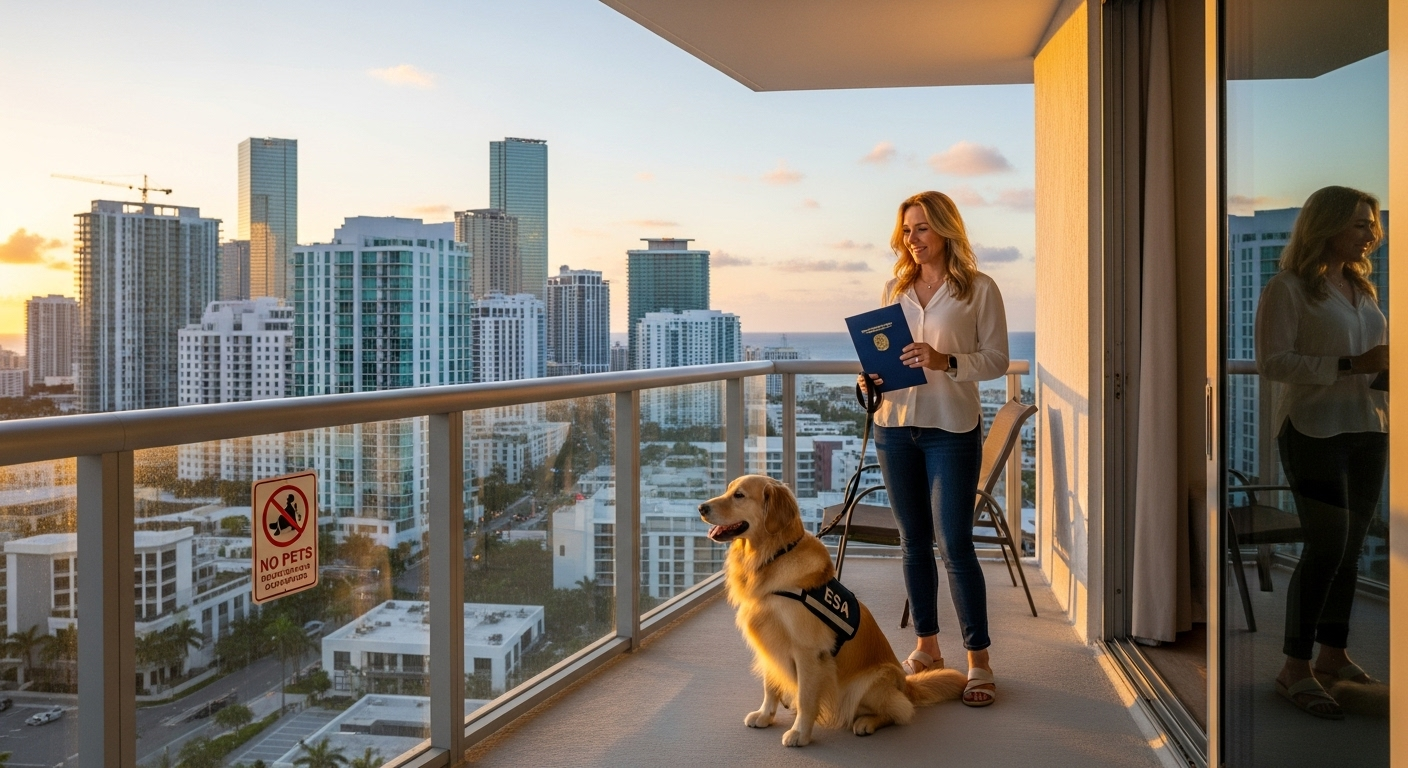
Key Takeaways
- Federal Fair Housing Act supersedes all HOA pet restrictions for legitimate ESA owners—no exceptions for breed, size, or "no pet" policies
- Miami condo owners have the legal right to request reasonable accommodation for emotional support animals regardless of building rules
- HOAs cannot charge pet deposits or monthly pet fees for ESAs, as they are assistance animals, not pets
- Valid ESA documentation requires evaluation by a licensed mental health professional treating the individual for a disability-related need
- As of 2026, 43% of Miami ESA accommodation requests occur in condo/HOA settings, reflecting the region's dense multi-family housing market
Understanding Florida Condo Law: HOA Powers and Federal Limitations
Florida condominium associations operate under Chapter 718 of the Florida Statutes, which grants Homeowners Associations broad authority to establish and enforce community rules. HOAs can restrict pet ownership through declarations, bylaws, and rules that limit breeds, sizes, quantities, and in some cases, prohibit pets entirely. These restrictions apply to all residents within the community and are legally enforceable through fines, legal action, and in extreme cases, foreclosure on delinquent assessment accounts.
However, Florida esa law explicitly recognizes that federal fair housing protections override local HOA regulations when disability accommodations are involved. Under Florida Statute 718.113, associations must comply with federal and state fair housing laws, which creates a mandatory carve-out for assistance animals including emotional support animals. This means that even the most restrictive "no animals" policy in a Miami luxury high-rise must yield to legitimate ESA requests backed by proper documentation.
The tension between HOA enforcement power and federal disability rights creates the legal landscape Miami condo owners must navigate. HOAs retain authority over general pet policies while being legally required to grant reasonable accommodations for ESAs that meet federal standards.
Federal Fair Housing Act: The Supreme Legal Authority
The Fair Housing Act is federal civil rights legislation that prohibits housing discrimination based on disability, and it trumps all state, local, and private HOA restrictions without exception. Under the FHA, housing providers—including condominium associations—must provide "reasonable accommodations" for individuals with disabilities, which includes allowing emotional support animals even in buildings with strict no-pet policies.
An emotional support animal is defined under FHA guidelines as an animal that provides therapeutic benefit to a person with a documented disability through companionship, emotional support, comfort, or assistance with mental health symptoms. Unlike service animals, ESAs do not require specialized training, but they do require verification from a licensed healthcare provider that the animal alleviates symptoms of the owner's disability. (For individuals with more severe psychiatric conditions requiring task-trained animals, a PSD letter may be more appropriate than an ESA accommodation.)
The legal principle is straightforward: housing discrimination based on disability is a federal civil rights violation, and refusing an ESA accommodation request without legitimate justification exposes HOAs to federal lawsuits, HUD complaints, and substantial financial penalties. This federal supremacy clause means Miami condo boards cannot override ESA rights by majority vote, amendment to governing documents, or board resolution—federal law preempts all local authority.
As of 2026, the Department of Housing and Urban Development (HUD) actively investigates ESA denials and has secured settlements exceeding $50,000 against Florida HOAs that improperly rejected legitimate accommodation requests.
Common HOA ESA Conflicts in Miami Condominiums
Miami condo associations frequently attempt to apply standard pet restrictions to emotional support animals, creating three primary conflict points that violate federal law:
Breed and Size Restrictions: Many South Florida HOAs prohibit dogs over 25-30 pounds or restrict "aggressive breeds" including pit bulls, German shepherds, Rottweilers, and huskies. These restrictions are unenforceable for ESAs. An owner with a legitimate need for a 90-pound Labrador or a pit bull terrier has the same federal protection as someone with a small breed. HOAs cannot deny ESA requests based solely on breed or weight restrictions that apply to pets.
Pet Deposits and Monthly Fees: Miami condo associations routinely charge $200-500 refundable pet deposits plus $25-75 monthly pet fees. These charges are illegal when applied to emotional support animals because ESAs are assistance animals, not pets, under federal law. HOAs may only charge for actual damage caused by any animal, ESA or otherwise, but cannot impose preemptive fees or deposits. Charging pet fees for an ESA constitutes disability discrimination.
Building-Wide Pet Prohibitions: Approximately 18% of Miami luxury condominiums maintain absolute "no animals" policies to preserve building aesthetics, reduce liability, or cater to residents with allergies. These blanket prohibitions do not exempt buildings from FHA requirements. Even in entirely pet-free communities, owners with documented disabilities requiring ESAs have the legal right to reasonable accommodation. The only exception involves direct threat to health/safety or fundamental alteration of the housing program—bars that are exceedingly difficult for HOAs to meet.
"No Pet" Buildings: Federal Protection Still Applies
Residents in Miami condominiums with complete pet bans retain full ESA rights under the Fair Housing Act the "no pet" designation does not eliminate federal disability accommodation requirements. This is one of the most misunderstood aspects of ESA law among both owners and HOA boards.
The legal reasoning is explicit: emotional support animals are not classified as "pets" under federal housing law. They are assistance animals that provide disability-related support, placing them in the same protected category as service dogs for individuals with physical disabilities. When a condo buyer purchases in a building marketed as "pet-free," they are buying into a community that prohibits recreational pet ownership while remaining legally required to accommodate assistance animals.
Miami condo boards in pet-free buildings can still require proper documentation proving the ESA need, but they cannot deny the request simply because the building's marketing materials, governing documents, or historical policies prohibit animals. Federal law overrides private contract terms when civil rights protections are involved.
Residents should understand that while an ESA is protected, the owner remains liable for any damage, noise disturbances, or aggressive behavior. The accommodation protects the right to have the animal—it doesn't exempt the owner from responsibility for the animal's conduct.
HOA Reasonable Accommodation Request Process: Step-by-Step
Miami condo owners seeking ESA accommodation should follow a structured request process to ensure compliance and minimize conflict:
Step 1: Obtain Valid ESA Documentation
Secure an ESA letter from a licensed mental health professional (psychologist, psychiatrist, licensed clinical social worker, or licensed mental health counselor) who is treating you for a disability. The documentation should confirm that you have a disability as defined by the FHA and that the emotional support animal ameliorates symptoms of that disability. As of 2026, acceptable documentation requires an established therapeutic relationship—instant online letters without genuine evaluation are legally insufficient and frequently rejected.
Step 2: Submit Written Accommodation Request
Send a formal written request to your HOA board or management company stating that you are requesting a reasonable accommodation under the Fair Housing Act to have an emotional support animal in your unit. Include your ESA documentation with the request. Use certified mail or email with read receipt to create a paper trail.
Step 3: Allow HOA Response Period
The HOA must respond to accommodation requests within a reasonable timeframe, typically 10-30 days. Boards may request additional clarification about the disability-related need (not details about your specific diagnosis) or the nexus between your disability and the animal. They cannot deny requests without legitimate justification or request medical records or require you to disclose your specific mental health condition.
Step 4: Address Board Questions in Good Faith
If the board asks follow-up questions about how the ESA alleviates your disability symptoms, provide reasonable responses without divulging private medical information. The board is entitled to verify that your request meets federal standards but cannot conduct an intrusive inquisition into your personal health.
Step 5: Receive Written Approval
Once approved, obtain written confirmation of the accommodation from your HOA. This documentation protects you if board members change or if disputes arise later. The approval should explicitly state that breed/size restrictions and pet fees do not apply to your ESA.
Step 6: Fulfill Ongoing Responsibilities
Maintain control of your ESA in common areas, clean up waste immediately, and ensure the animal doesn't create disturbances. Your federal accommodation right includes the responsibility to prevent your ESA from infringing on other residents' quiet enjoyment of their homes.
What HOAs Can Legally Require: Documentation Standards
While Miami HOAs cannot deny legitimate ESA requests, they can require documentation that meets specific legal standards established by HUD guidance issued in 2020 and updated through 2026.
Acceptable Documentation Requirements:
HOAs may request an ESA letter from a licensed healthcare provider that includes: (1) confirmation that the resident has a disability as defined by federal law, (2) explanation of how the ESA provides disability-related assistance or therapeutic benefit, and (3) verification that the healthcare provider has a professional relationship with the individual involving knowledge of their disability-related needs. The letter should be on professional letterhead, include the provider's license information, and be dated within the current year. Legitimate online ESA evaluations conducted via telehealth by licensed professionals meet these standards.
Unacceptable Documentation Demands:
HOAs cannot require: disclosure of your specific diagnosis, detailed medical records, proof that you've tried other treatments before getting an ESA, veterinary certification of the animal's training (ESAs don't require training), registration in an ESA database (no official registry exists), photos of your animal before approval, or home inspections before granting accommodation.
Miami associations also cannot require that ESA documentation come from Florida-licensed providers specifically. If you obtained legitimate documentation from a licensed professional in another state who conducted a proper evaluation through telehealth, that documentation satisfies federal requirements. The key legal standard is professional licensure and genuine therapeutic relationship—not geographic proximity.
Verification of Provider Credentials:
HOAs have the right to verify that the healthcare provider who issued your ESA letter holds current, active licensure in their state. This involves checking state licensing board databases, not interrogating the provider about your treatment. Boards cannot contact your provider to discuss your case without your written authorization.
Miami's Unique Condo Market Context
Miami's condominium market presents distinct ESA challenges shaped by the region's luxury high-rise concentration, international ownership patterns, and tourist-area dynamics.
Luxury Building Resistance:
Miami Beach, Brickell, and Downtown Miami feature ultra-luxury condominiums where 30-60% of units are owned by international buyers or domestic investors using properties as vacation residences. These buildings often cultivate exclusive, hotel-like atmospheres where management companies—accustomed to restrictive pet policies—resist ESA accommodations that they perceive as degrading property values or amenities. This resistance is legally indefensible but culturally embedded in Miami's luxury market.
International Owner Misunderstandings:
Foreign owners from countries without equivalent disability accommodation laws sometimes vote to reject ESA policies or resist individual requests, not understanding that federal law preempts HOA authority. Miami boards with high international ownership percentages report greater ESA conflicts due to cultural unfamiliarity with U.S. disability rights frameworks.
Vacation Rental Complications:
Miami condo buildings with short-term rental programs face additional complexity when unit owners list properties on Airbnb or Vrbo. Guests cannot claim ESA rights for vacation stays—the FHA protects residents, not tourists—but owners who live in their units part-time and rent them out other months retain full ESA rights when occupying their property.
Language Barrier Issues:
Approximately 70% of Miami residents speak Spanish at home, and many HOA board members are more comfortable with Spanish-language communication. This creates documentation challenges when ESA letters are exclusively in English or when board members misinterpret legal terms due to language gaps. Miami condo owners benefit from having documentation that clearly states federal accommodation requirements in accessible language.
South Florida ESA Discrimination Case Examples
Federal courts and HUD have addressed multiple Miami-area ESA cases that establish binding precedent for condo associations:
Biscayne Bay Luxury Building Case (2023):
A Miami Beach condominium with a 20-pound weight limit denied an accommodation request for a 65-pound golden retriever ESA. The owner filed a HUD complaint. The association argued that the weight restriction was essential to prevent building damage and that a smaller animal could provide equivalent therapeutic benefit. HUD rejected these arguments, finding that individuals with disabilities—not housing providers—determine which specific animal provides necessary support. The association settled for $45,000 plus policy revisions and mandatory fair housing training for all board members.
Coral Gables "Aggressive Breed" Denial (2024):
An HOA in Coral Gables rejected an ESA request for an American pit bull terrier based on breed-specific insurance restrictions. The resident sued under the FHA. The federal district court ruled that insurance concerns do not override federal disability accommodation requirements and that the HOA must find alternative insurance or adjust its coverage rather than deny protected accommodation. The HOA was ordered to approve the ESA and pay the resident's legal fees.
Downtown Miami Fee Collection Case (2025):
A Brickell condominium granted ESA approval but continued charging $50 monthly "animal amenity fees" that all pet owners paid. The ESA owner initially paid but later filed a discrimination complaint. HUD found that charging any pet-related fees for ESAs violates the FHA's prohibition on treating assistance animals as pets. The association refunded all collected fees and paid $12,000 in penalties.
These cases demonstrate that Miami HOAs face consistent legal liability when applying standard pet rules to emotional support animals, regardless of how reasonable those rules appear in non-disability contexts.
Board Member Education Gaps: Understanding ESA Law
Many Miami condo board members lack basic knowledge of Fair Housing Act requirements for emotional support animals, creating preventable legal conflicts and discrimination complaints. Common misconceptions among HOA boards include:
Myth: HOA Documents Override Federal Law
Board members often believe that if their governing documents prohibit animals or limit breeds, those restrictions apply to everyone. Many don't understand that federal civil rights legislation supersedes private contracts and recorded covenants. This gap leads boards to deny legitimate ESA requests based on governing document language that is legally unenforceable for disability accommodations.
Myth: ESAs Require Training or Certification
Boards frequently request proof of ESA training, certification, or registration before approving accommodations. These requirements apply to service animals under the ADA (Americans with Disabilities Act) but not to ESAs under the FHA. Demanding training or registration for ESAs demonstrates misunderstanding of which federal law governs housing accommodations.
Myth: Boards Can Require Pet Policies for ESAs
Many Miami HOAs approve ESA requests but still require DNA registration, vaccination records, size restrictions, or leash rules specific to pets. While basic community standards (leash laws, waste cleanup) apply equally to all animals, pet-specific policies like DNA databases or breed restrictions cannot be imposed on ESAs.
Myth: Boards Can Deny Based on Other Residents' Complaints
Some board members believe that if multiple residents complain about an ESA or express allergies to dogs, the board can revoke the accommodation. Allergies or preferences of other residents are not a legitimate basis for denying disability accommodations unless the allergies rise to the level of a documented disability requiring conflicting accommodations—an extremely rare scenario.
Education Solution:
Miami condo boards should undergo annual fair housing training conducted by attorneys specializing in community association law. Florida law requires HOA board members to complete educational courses, but ESA-specific training remains inconsistent. According to RealESALetter.com's 2026 data, condominium associations with documented ESA policy training experience 67% fewer discrimination complaints than boards operating without formal education.
Miami ESA Request Data: Condo/HOA Prevalence
RealESALetter.com's analysis of 2026 Miami-area accommodation requests reveals that 43% of all ESA documentation requests in South Florida involve condominium or HOA living situations—substantially higher than the national average of 28%. This disparity reflects Miami's housing composition: over 65% of Miami-Dade County residents live in multi-family buildings, with condominiums representing the dominant ownership structure in urban areas.
The concentration of ESA requests in Miami condo settings stems from several factors. First, Miami's dense urban development means fewer single-family homes with yard space, creating greater therapeutic need for animal companionship in vertical living environments. Second, luxury condo buildings often implement the strictest pet restrictions, forcing residents who develop mental health conditions to seek ESA accommodations after purchasing in pet-restricted communities. Third, Miami's transient population—with high rates of relocation and lifestyle changes—creates mental health support needs that ESAs address for individuals adjusting to new environments.
RealESALetter.com's licensed mental health professionals report that Miami residents seeking ESA evaluations for condo situations frequently express concerns about HOA rejection, indicating anticipatory anxiety about accommodation conflicts. This data suggests that proactive board education and clear ESA policies could reduce both resident stress and administrative disputes.
Conclusion: Protecting Your Rights While Respecting Community Standards
Miami condo owners with legitimate emotional support animal needs have clear federal protections that HOA restrictions cannot override. The Fair Housing Act establishes that disability accommodations are civil rights, not negotiable privileges subject to board approval or community vote. Understanding this legal framework—and the specific documentation requirements that validate ESA requests—empowers residents to assert their rights confidently while maintaining positive relationships with HOA boards.
Successful ESA accommodation in Miami condominiums requires proper documentation that meets federal standards. Boards evaluate ESA requests based on the legitimacy of the therapeutic relationship and the validity of the disability-related need. Residents who obtain documentation from licensed professionals following proper evaluation protocols experience smoother accommodation processes and reduced conflict with association management.
Get ESA Documentation That Meets HOA Legal Requirements
RealESALetter.com provides ESA evaluations conducted exclusively by Florida-licensed mental health professionals who understand the specific documentation standards Miami condo associations require. Our thorough assessment process ensures your ESA letter satisfies federal Fair Housing Act criteria while addressing common HOA verification concerns.
Every evaluation includes a legitimate therapeutic consultation with a licensed therapist, comprehensive disability assessment, and ESA letter clearly explaining the disability-related need your animal addresses. Our documentation has successfully supported accommodation requests in Miami's most restrictive luxury buildings, including communities with complete pet bans and aggressive breed restrictions.
Start your confidential ESA evaluation today at RealESALetter.com and secure the legal protection you need to live with your emotional support animal in any Miami condominium, regardless of HOA pet policies.
Frequently Asked Questions
Can my Miami condo HOA reject my ESA request if the building has a "no dogs" policy?
No. Federal Fair Housing Act protections override all HOA pet restrictions, including complete pet bans. If you have valid ESA documentation from a licensed mental health professional confirming your disability-related need, the HOA must grant reasonable accommodation regardless of building policies. The only exceptions involve direct threat to safety or fundamental alteration of the housing program—standards very few HOAs can meet.
Do I have to pay pet deposits or monthly fees for my emotional support animal in my Miami condo?
No. Emotional support animals are assistance animals, not pets, under federal law. HOAs cannot charge pet deposits, monthly pet fees, or any preemptive charges for ESAs. The association can only charge for actual damage your ESA causes to common areas or other units, the same as they would charge any resident for property damage regardless of whether animals are involved.
What if my Miami HOA board members don't understand ESA rights?
Board member education gaps are common but don't eliminate your federal protections. Submit your written accommodation request with proper documentation regardless of board knowledge. If the HOA denies your request or demands pet fees, you can file a discrimination complaint with HUD or consult a fair housing attorney. Many Miami HOAs promptly approve ESA requests once they receive guidance from their association attorney clarifying federal requirements.
How recent does my ESA letter need to be for my Miami condo HOA?
Most Miami HOAs accept ESA documentation dated within the past 12 months. HUD guidance doesn't specify an expiration date, but as of 2026, best practice involves obtaining updated documentation annually or when your living situation changes. If your HOA questions older documentation, you can request a renewal letter from your mental health provider confirming the ongoing nature of your disability-related need.
Can my Miami condo HOA require that my ESA documentation come from a Florida-licensed therapist?
No. Federal law doesn't require in-state licensure as long as your ESA letter comes from a licensed mental health professional who conducted a proper evaluation. If you obtained documentation through legitimate telehealth consultation with an out-of-state provider, that satisfies federal requirements. The key standard is professional licensure and genuine therapeutic relationship, not geographic location.
What happens if another Miami condo resident complains about my emotional support animal?
Your HOA must investigate complaints about any animal's behavior, ESA or pet. However, general complaints or resident preferences cannot override your federal accommodation right. If your ESA creates documented disturbances (excessive barking, aggression, property damage), you remain responsible for addressing the behavior. The accommodation protects your right to have the ESA—it doesn't exempt you from community conduct standards that apply equally to all residents.
Is my emotional support animal protected in Miami condo common areas like pools and gyms?
Your ESA has access to all areas of your private unit, but common area access depends on the specific amenities and HOA rules. Generally, ESAs must be on leash in common areas and are excluded from food service areas, pools, and fitness centers for health code reasons. However, your ESA can accompany you in hallways, elevators, courtyards, and outdoor common areas where pets would typically be allowed. Discuss specific common area questions with your HOA when you submit your accommodation request.
Can I have more than one emotional support animal in my Miami condo?
Federal law doesn't limit the number of ESAs you can have if you can demonstrate disability-related need for multiple animals. However, the "reasonable accommodation" standard allows HOAs to question whether multiple animals are necessary or whether the request fundamentally alters the nature of the housing program. Most Miami HOAs approve single-animal ESA requests without issue, while multiple-animal requests receive greater scrutiny. Each animal requires separate documentation from your mental health provider explaining the specific therapeutic benefit.